
Brain breaks are short and active activities (1–3 minutes) that allow students to move, reset their minds and return to learning with improved focus. They are particularly helpful after long periods of sitting or listening. Brain breaks do not require special materials and can be done inside or outside the classroom.
Calming Brain Break Ideas:
| Stretch and Reach |
| Students stand beside their desks and: – Reach both hands to the sky. – Touch your toes. – Stretch arms left and right. – Roll shoulders forward and backwards. This helps students relax muscles and increase blood flow to the brain. |
| Deep Breathing Reset |
| Students sit quietly and take three slow breaths. Teacher modelling how to: – Breathe in slowly – Hold for two seconds – Breathe out slowly This helps calm the brain and support emotional regulation. |
| Quick Nature Walk |
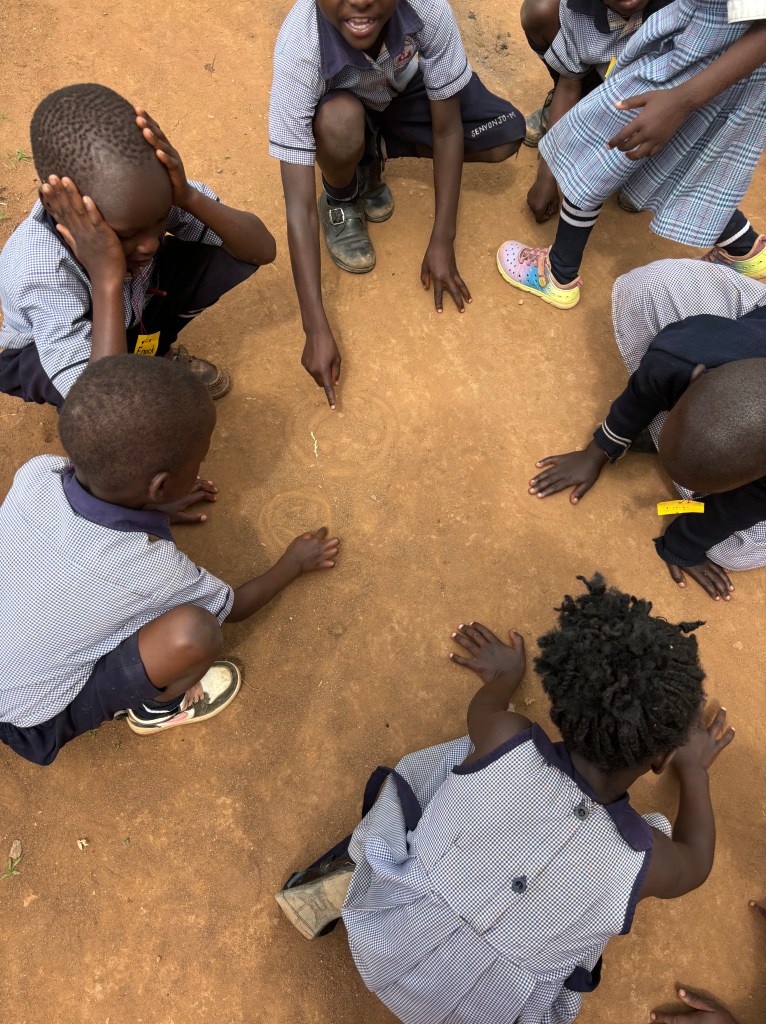
| If space allows, take students outside for 2 minutes. Students can: – Stretch – Walk in a circle – Draw in the dirt/with water – Look for something green, round, or small This refreshes the mind and connects learning with the environment. |
Energising Brain Break Ideas:
| Stand Up – Sit Down |
| Students respond physically to questions. Example: – Stand up if you like football. – Sit down if you like reading. – Stand if you think the answer is 10. This helps students move while also reviewing learning. |
| Simon Says |
| The teacher gives instructions beginning with “Simon says.” Example: – Simon says touch your head – Simon says clap three times – Jump twice – Turn around *If the teacher does not say “Simon says,” students should not perform the action. This builds listening skills and attention. |
| Follow the Leader |
| One student stands at the front and performs simple actions while others copy. Examples: – Jumping – Stretching – Marching – Clapping rhythms Rotate leaders so many students get a turn. |
| Action Alphabet |
| Teacher calls a letter and students perform a movement for that letter. Example: – A – Arms up – B – Bend down – C – Clap You can also ask students to say a word beginning with the letter. |
| Odd or Even Jump |
| Teacher calls out a number. Students respond with movement: – Odd number → Jump – Even number → Clap This reinforces number recognition and patterns. |
| Animal Movements |
| Teacher calls out animals and students move like them. Examples: – Frog jumps – Bird flapping arms – Elephant stomping – Monkey swinging arms This is especially effective for younger students. |
| Jump Count |
| Students stand and jump while counting aloud. Teacher instructions: – Jump while counting to 20. – For older students, count in 2s, 5s, or 10s. This combines movement with numeracy practice. |
| Jump the Syllables |
| Teacher says a word and students jump once for each syllable. Example: – Ta-ble → 2 jumps – Ba-na-na → 3 jumps This supports phonological awareness. |
| Spell and Move |
| Teacher calls out a simple word and students spell it aloud while performing actions. Example: D-O-G – D → clap – O → jump – G → spin |

