
Section 1
Active learning strategies, also known as hands-on learning, refer to teaching tools that incorporate student interaction and engagement in a range of ways. They are essential because they transform students from passive recipients of information into active participants, significantly improving information retention, critical thinking and engagement (Teaching Heart & Soul, 2024)
Active learning strategies benefit both learners and teachers. They allow for an engaging environment to be developed, encouraging children to develop a desire for learning (Teaching Heart & Soul, 2024). Learning that is engaging and relevant to students is beneficial for maintaining steady wellbeing of students, as they are enabled opportunity for movement, socialisation, contextualised learning and independence.

Further, these types of strategies provide greater scope for differentiation, allowing teachers to identify the uniqueness of their students and allow opportunity for different ways of developing skills (Teaching Heart & Soul, 2024).

Children using nature items to count with during a Mathematics lesson
Section 2
How are Active Learning Strategies used in planning?
Effective lessons and units balance theory and practice. Students learn best when they not only receive information but also apply it in meaningful, real-world contexts. Hands-on learning allows learners to explore, experiment and engage multiple senses, helping them understand concepts concretely before thinking abstractly (D’souza, G. 2017).
The Active Learning Strategies explored in this website are designed to help teachers plan by using the existing content from their country’s curriculum and make small adjustments around the delivery of such content.
These active learning strategies can be used one at a time or combined within lessons. Taking one concept and considering how it can be explored using observations, hands on tools, questioning, independent thinking and movement is the goal. Lesson plan examples are included within the resources tab.
Section 3
How do Active Learning Strategies link to our biblical responsibility as Christian educators?
God created us as complex individuals, each unique in the way we learn and experience the world around us. Isaiah 64:8 tells us that “yet you, Lord, are our Father. We are the clay, you are the potter; we are all the work of your hand.” This means that we all have differences; in the way we think, act and in what we are interested in. By implementing a range of active learning strategies into teaching and planning, there is more success in meeting the variety of needs, learning styles and interests represented by the many students in a class (p. 100, Effective Teaching and Learning Series 2, 2021).
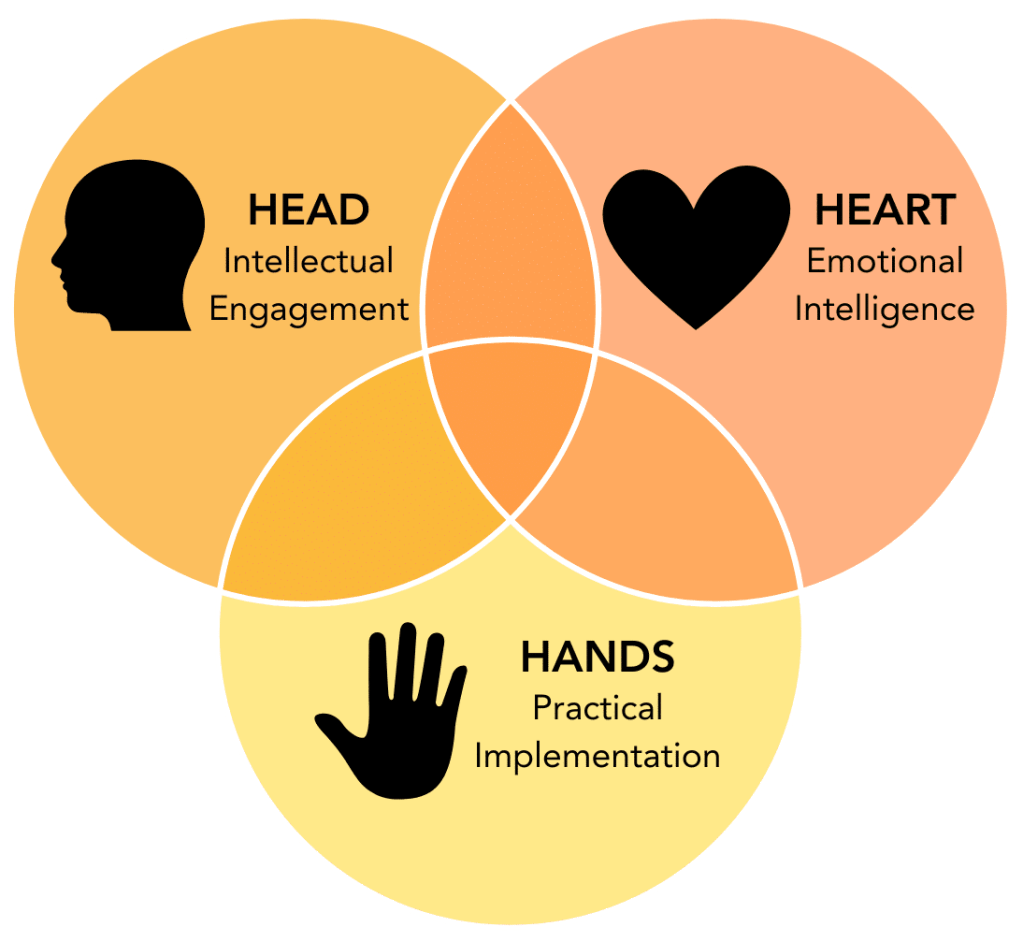
Each child is carefully crafted with a head, heart and hands. A head to think and comprehend, a heart to feel, socialise and connect with and hands that require engaging with the real world around them to practically apply their knowledge (p. 146, Effective Teaching and Learning Series 2, 2021). Incorporating lessons that provide opportunities for all three areas to be targeted creates a holistic approach to education and results in inspired and engaged students.
Active learning strategies also provide many opportunities for community to be built within the classroom, where students are encouraged to work together as a team, encouraging one another and building each other up. Hebrews 10:24-25 tells us to ‘consider how we may spur one another on toward love and good deeds, not giving up meeting together, as some are in the habit of doing, but encouraging one another…’ Community learning is at the core of Christian Faith, as God calls us to journey life together (Smith, D. 2025).
David Ware’s book, ‘Jesus the Teacher’ encourages educators to view education through the lens of how Jesus taught. His book explores how Jesus constantly considered and catered to the interests of the audience that He was talking to. Jesus was engaging and diverse in His teachings, using many questions and stories to provoke thinking. Jesus also considered the emotional well-being of His audience, whether He was teaching one individual or an entire group. He was considerate to their personal situations and catered His delivery and content accordingly (Ware, D, 2023).

Jesus’ teachings were a reflection of who He is, what He was teaching and who He was teaching.
David Ware, 2023
Therefore, Jesus’ teaching is not simply a set of strategies that can be directly applied to a teachers’ own practice. His teachings were a reflection of who He is, what He was teaching and who He was teaching. So His teachings can be used as an inspiration for us to consider in our own teaching (Ware, D, 2023, p. 36). We are encouraged to think about who we are, what we are teaching and who we are teaching when considering how to convey each topic and concept in our planning.
Section 4
Evidence for the benefit of Active Learning Strategies
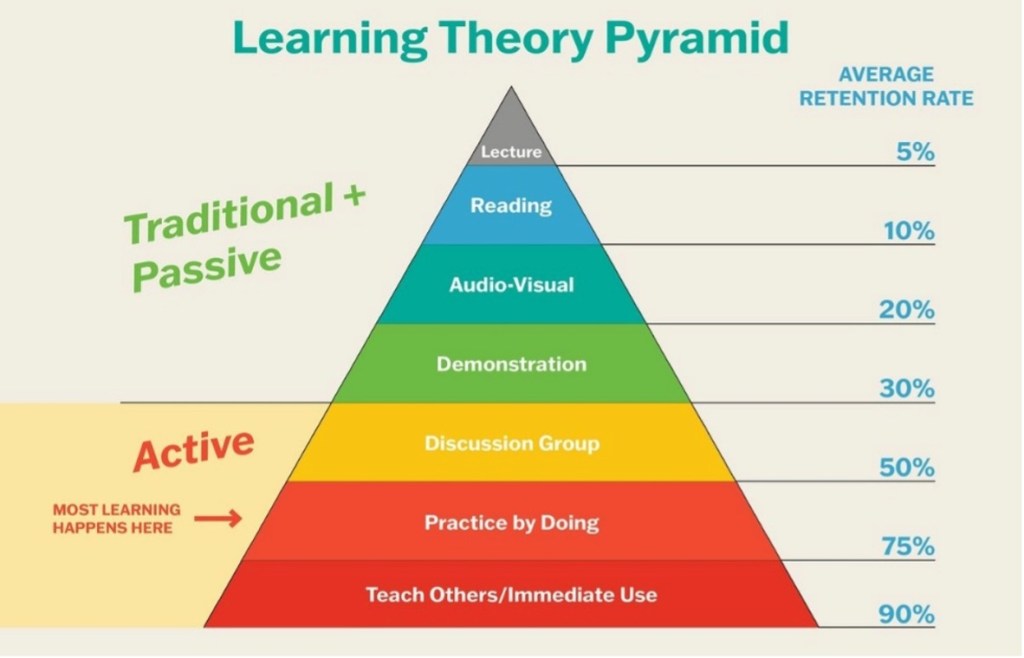
It demonstrates the significant difference between the success in retaining knowledge when learned through active learning compared to passive learning (rote learning strategies).
Evidence such as this informs the need to be mindful when planning units and individual lesson plans, ensuring there is a range of passive and active learning strategies incorporated to teach each concept and skill.
It is also important to consider the progression of the day when multiple educators are teaching a single class their different subjects. For example, if a science teacher has just conducted a lesson where students have been required to copy information/answer questions from a text or blackboard and then that same class is transitioned straight into a Mathematics lesson, it would be ineffective for them to spend their Mathematics lesson also engaging in a similar passive learning style. It would be more effective if teachers were mindful of each other’s teaching practices to ensure students are receiving a range of engagement throughout the day. Best practice would be for each teacher to incorporate some level of active learning into every lesson.
Further considerations around managing student engagement across the day include the attention span of students of different ages. The table below explores the average attention span for students split into their age brackets, informing educators on how much time they should be expecting students to remain focused on a single topic/task before allowing some sort of break.
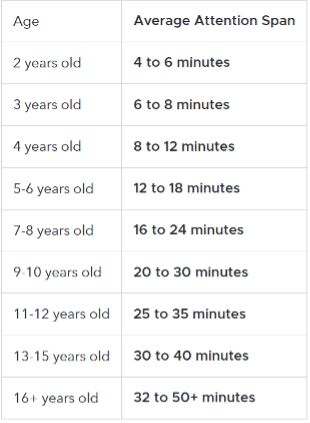
This data demonstrates the need for ‘brain breaks’ within lessons, allowing students to move their bodies, reset their minds and refocus back into the task or onto a new concept.

