
Differentiation in teaching requires simply seeing students as individuals, who each learn in their own unique way, at their own pace and with different interests driving their engagement (p. 31, ETLS, 2021). This may sound overwhelming to think about in the context of a classroom. How are we supposed to cater for all of our students’ individuality when there is only one of us? But it is simply being aware of this uniqueness that is often enough. The goal is to make the accommodations that can be realistically made and then to have grace for our students as they engage in our lessons (p. 31, ETLS, 2021).
Equality vs. Equity
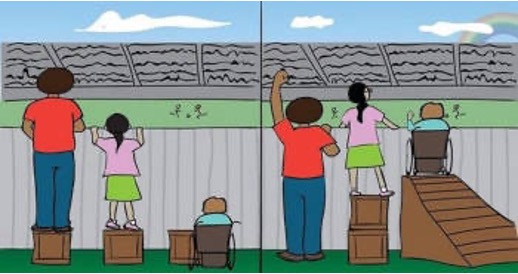
A way to view differentiation is Equality vs. Equity. In teaching, this refers to ‘providing personalised resources and support based on individual student needs to ensure everyone has a fair chance to succeed, rather than giving every student the exact same, “equal” tools regardless of their circumstances. While equality is sameness, equity is fairness, acknowledging different backgrounds to achieve equal outcomes’ (Australian Rights Commission, 2022).
The following image illustrates the difference between equality and equity clearly, where it is evident that the participants in the image on the left are being provided with equal adjustments and identical expectations, which leaves two of the participants unable to access the game (learning) in the same way as the first participant. Whereas the image on the right demonstrates differentiation being implemented, allowing all participants to access the game (learning) and thus, be provided with an equal chance at success.
| Equality | Equity |
Acknowledging the need for differentiation in the classroom is another demonstration of Faith-based teaching. Understanding that all children and adults, are designed uniquely by God means planning with such uniqueness in mind.
Active Learning strategies support this planning as implementing a range of different activities into your day and week can help cater for the range of learning styles exhibited by the students in your classroom.
Setting up lessons so that there is scope for differentiation can take some practice, but the following are some examples of differentiation.
Differentiate by Content
–What students learn–
| Differentiating by content involves adjusting what students access while keeping learning intentions consistent. Teachers provide the same core concept using materials at varying levels of complexity or through different formats to ensure accessibility for all learners. |
| Tiered materials – Students explore the same topic using texts or resources at different reading levels or cognitive demands. Mini-lessons – Targeted small-group instruction provides direct teaching based on identified needs. Choice of texts and resources – Learning may be accessed through articles, videos, visuals, audio, or hands-on materials. Pre-teaching vocabulary – Key terms are explicitly taught before lessons, supporting ESL learners and students with language or learning difficulties. |
| Examples – When assessing for reading abilities, provide students with texts that are at their level of reading. – Some worksheets/tasks may require simpler instructions or more scaffolded steps, such as when assessing for verb knowledge by creating sentences using verbs, some students may be able to think of a sentence on their own while others may need pre-written sentences where they need to fill in the missing verbs. This could be done in sections, where some students extend onto the more difficult options while others remain only on simpler sections. -This is also when the group work active learning strategy is effective. |
Differentiate by Process
–How students learn–
| Differentiating by process focuses on how students make sense of learning. Instruction is designed with varied pathways so students can engage, practise and understand concepts in ways that suit their learning needs. |
| Flexible grouping – Students work individually, in pairs, or in small groups that change based on task, skill, or learning goal. Learning stations or centres – Tasks vary in difficulty, pace, or approach, allowing students to rotate through learning experiences. Scaffolding – Supports such as sentence starters, graphic organisers, checklists, or guided questions help students succeed. Think-alouds and modelling – Teachers explicitly demonstrate thinking processes and strategies to support understanding. |
Differentiate by Product
–How students show learning–
| Differentiating by product allows students to demonstrate understanding in different ways while working toward the same learning outcome. This supports diverse strengths and communication styles. |
| Choice boards – Students select from a range of options to show learning. Multiple output options – Students may write, present, draw, build, role-play, or record responses. Tiered assignments – Tasks vary in depth, complexity, or length while maintaining the same goal. Rubrics with levels – Clear success criteria support students working at different proficiency levels. |
Differentiate by Pace
–How fast students work–
| Differentiating by pace recognises that students learn at different speeds and require varying amounts of practice or challenge. |
| Extension tasks – Open-ended or deeper-thinking activities are available for early finishers. Chunked tasks – Learning is broken into manageable steps to reduce overwhelm. Flexible deadlines – When appropriate, students are given additional time to demonstrate understanding. Anchor activities – Meaningful independent tasks students can engage with at any time. |
Differentiate by Readiness
–Where students are starting from–
| Differentiating by readiness ensures instruction meets students at their current level of understanding and skill development. |
| Pre-assessments – Quick checks identify prior knowledge and inform planning. Skill-based grouping – Temporary groupings allow targeted instruction and support. Targeted questioning – Teachers adjust question complexity during discussions to stretch or support learners. |
Differentiate by Interest
–What motivates students–
| Differentiating by interest increases engagement by connecting learning to what students care about and find meaningful. |
| Student choice – Learners choose topics, examples, or formats where possible. Real-world connections – Learning is linked to students’ lives, experiences and future applications. Interest surveys – Teachers gather information to design relevant and motivating tasks. |
Differentiate by Learning Profile
–How students learn best–
| Differentiating by learning profile acknowledges that students have unique preferences, strengths and cultural backgrounds. |
| Multiple learning modes – Visual, auditory and kinaesthetic approaches are intentionally included. Work environment choices – Opportunities for quiet, independent work or collaborative learning are provided. Cultural relevance – Examples, language and contexts reflect students’ backgrounds and experiences. |

